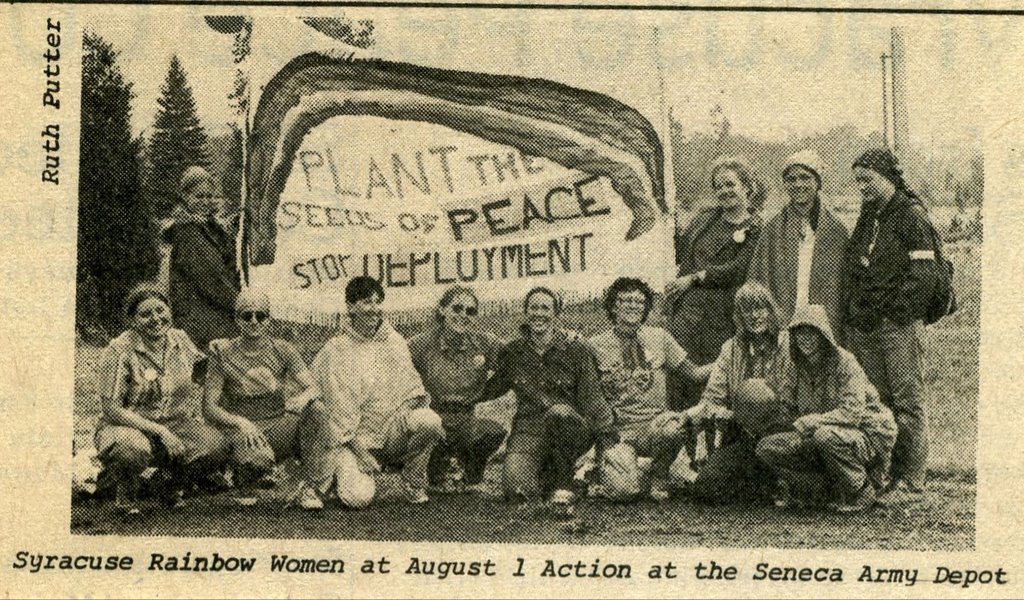
Sunday, August 20, 2006

HeRSToRy 002 Carolyn Mow

     Carolyn was a member of an anti-war group in Ithaca, NY called Women Against Militarism (WAM). She had already been arrested at actions at Griffiss Airforce Base and spent 10 days in jail as part of the first Women’s Pentagon Action in 1980, when the idea of a women’s peace camp in the U.S. took hold. WAM joined with like-minded groups from Buffalo, Rochester and Syracuse to form the Upstate Feminist Peace Alliance and began planning the Women’s Encampment for a Future of Peace and Justice. Carolyn was a primary organizer in the year leading up to the Encampment and committed civil disobedience twice at the Seneca Army Depot in 1983, the second action resulting in jail time. Her involvement with WEFPJ ended after the first summer. 

Audio excerpt from Carolyn's interview:
TRANSCRIPT: "We had a really large affinity group for that action and we had gone through this whole thing of figuring out how, because about half the group did not get arrested. And they, and we had a big circle that was half inside and half outside the fence because we had this whole thing of wanting the support people to feel equally part of it. And we had all made these mask, one of these women did this whole thing, we made, we put plaster on our faces and let it dry, so we made our own face mask and then we painted them and we brought them and we hung them on the fence. So that was why we didn't want go later with everybody because we wanted to do our own thing. It took them a while, so it took them a while to find us. Actually, the thing I remember, just sort of one of these little non-violent stories.  The time we got arrested on the airfield was the first action of the summer so the base people were totally not expecting us and I think really unclear what to expect. And they, you know, so, and by the time they got there we had the tent up and were sitting becasue they just didn't know, we went under the fence actually, that was before they had reinforced the bottom of the fences. And the thing that really struck me, was that we were just sitting there in a circle next to the tent. And these jeeps all pulled up and parked all around us and these guys all got out with these big billy, and I saw this guy gets out with this big billy club and then he like looks around and then goes and puts it back in the truck.  He got it, phew. Because we didn't know, are they going to be rough with us? And it was just like, okay, he got it. We're fine."
Interview: Carolyn Mow
Date: October 22, 2005
Location: Phoenicia, NY
Present: Estelle Coleman, hershe Michele Kramer


Carolyn (left), with Michelle Crone at the newly purchased peace encampment land, June 1983. Photo by Nancy Clover.
1983 ARCHIVE VIDEO:
Women's Video Collective. All Rights Reserved. Copyright 1983.
Carolyn sharing information, July 16, 1983, in the pavillion at the encampment in preparation for the August 1st mass civil disobedience action.  

How do you remember the idea of the camp evolving?
Well, I’ll tell you how I remember it and we’ll see how different it is from everybody else, right? I went to the Women’s Pentagon Action (1) in ’80 and, I guess in ’81, too. I remember ’80 more because that was my first big thing like that. Exactly how we got together I don’t know, but the Women’s Pentagon Action was definitely what lead to the peace camp in some way, I think because it was the first big women’s peace action like that. There was a women’s peace group in Rochester and one in Syracuse and one in Ithaca and at some point we said, “let’s start moving and let’s get together.” I think it was after we came back in ’81 that we decided to do other things and for a while all the local groups called themselves Rochester, Syracuse, Ithaca Women’s Pentagon Action. We planned a women’s action up at Seneca Army Depot (2) - that must have been in 1982 and then Greenham Common (3) was happening and so we had this feminist thing happening that was sort of focused on the Seneca Army Depot and our region and then we got the idea of having a peace camp. But we really did think in the beginning that we were just going to go and set up our tents - we didn’t think we would buy the land – we thought we would do like Greenham Common and camp out and get arrested. We had no idea it would turn in to such a big thing. 

Can you talk about the politics behind the Women’s Pentagon Action?
I don’t know if I can even put it into words anymore because it was kind of new to me then and very exciting. There was a Call to Action for the Women’s Pentagon Action – a pretty long statement that was really beautiful and inspired me greatly at that time. The set of ideas included anarchism, consensus decision-making and changing economic structures – sort of everything. It was about feminism and peace and more than that, it was the way of seeing peace as being more than just stopping war but bringing justice and all sort of other ways and so even though we called the peace camp the Women’s Peace Camp, it was a long meeting in which we decided to officially call it the Women’s Encampment for a Future of Peace and Justice which was not such a good sound bite and nobody ever really called it that but we were trying to include some broader sense of what it was about. I had been arrested once, but not with any big consequences – at an anti-nuclear thing at Shoram. The Women’s Pentagon action was the first time I went to jail - it was quite an experience. I did something that I have since always discouraged people from doing - I got arrested when I was completely unprepared. We had a bus of women who went from Ithaca and no one had prepared for arrest. We didn’t have an affinity group - three of us just hooked onto this Albany group at the last minute and got arrested and we were completely unprepared for it. They took us right from the action in chains - our hands and feet were chained… and we were on the bus all night. It was only 10 days but they sent us down to Alderson, West Virginia and the people who were first-timers were there for 10 days and the people who were second-timers were there for 30 days. I don’t even remember what our charges were - some form of obstructing or blockading, but the people who pled No Contest were the people who went straight to Alderson. I hadn’t really planned on getting arrested and it made sense to me at that moment to plead No Contest. That was where I first met Susan Pines and Kate Donnelly and some of the other people who were involved in starting the peace camp – we met in jail.  


How long before the summer of 1983 opening did you start planning the camp?
My vague idea is that we probably started planning it about a year before and I think that fairly early in that planning process that at least some of the New York City people we had met at the Pentagon action got involved - Susan and Kate who I was in jail with after the Women’s Pentagon Action and they were involved in the camp pretty early on. I don’t remember exactly when people from Boston, Albany and Philadelphia started participating but it grew so that we had a planning group that was broader than our local groups. I remember there was a WILPF (4) person from Philadelphia, Donna Cooper and I think, it took off when WILPF showed up but I don’t know if I thought it was all of sudden. It’s too long ago for me to really remember. But I know that when it came to the idea of buying the land – that was a bit shocking for everyone. Somehow we managed to come to a decision to agree that we would buy that piece of land, now that I think about it, I can’t imagine the discussion that led to that. I know some of the people who had a lot of experience with the women’s festival in Michigan (5) in terms of knowing how to set up the space and knowing what you needed to have for people to camp there and all of that logistical part. Michigan was a piece of the whole background to the Peace Camp – a lot of Michigan women came, and a lot of the daily life stuff at the camp came from people’s experience at Michigan. I’m just thinking that along with WPA, Michigan was one of the precursors that made the peace camp what it was.

What sticks out in your mind from that time?
You know when I think back, the things that I remember most are some of the transitions that were from, our - I call it local group, but it was that regional group. As the camp became bigger, there were many stages of letting go and one stage of letting go was when we were working with other people but it became much bigger than us. The other big one was when the peace camp actually started – there was a group of women, maybe 20 of us at the most who had been working for a year to plan it and then people came. All these women came for the opening of the peace camp and it was suddenly like, OK, actually, sticking to our principles, we are no longer the decision-makers of this group who have been making all of the decisions all along and suddenly now whoever is here is part of the decision making process. So that was a big. That was really hard. I don’t know that we had quite forseen how hard that was going to be. It was a struggle to live up to and practice to what we’d theorized - and all of the attempts to work things out between really radical lesbian feminist women with much more mainstream straight women trying to all work together was, I think the beautiful - one of the many beautiful things that happened at the camp. The big thing that I remember in the first transition from pre-peace camp to starting-peace camp was that we had made the, later realized, very stupid decision to open on July 4th and we had received a challenge from a local figure that if we weren’t anti-patriotic we better fly our flags. Where was our flags? And it came up because the official opening was supposed to be July 4th so that the challenge about, why aren’t you flying the flag. But people, but women were already there and there was definitely the perspective of, nope, no way – the flag stands for nothing but oppression! And other people were, no, we want to reclaim this symbol of freedom or whatever that was – that was not my perspective. And I think that it took the better part of a day to decide what to do about that - I don’t remember who facilitated that process but somebody did and it was long.

In those transitions was the conflict first-wave organizers vs. newcomers or straight vs. lesbian or radical politics vs. organizational local politics?
All of that, all of that - we crossed all, people crossed all kinds of lines in terms of that but I think first there was more sort of locally-focused versus outside influences and then there was always lesbian/straight trying to work things out in terms of visibility and how that affected the relationship with the local community. My sense was that the people who really tended to move in and stay were more radical lesbian feminists and the more mainstream straight women came for a while the first summer but weren’t the people who moved in. It was kind of for better or worse that people who were dealing with their own emotional stuff were drawn to the camp. There were a lot of struggles about people being there who needed a lot of support and took a lot of energy from other people who were there and people had very different ideas about what they wanted the peace camp to be in the long run and what kind of work it made sense to do. I never lived in that house but I had a tent pitched there probably all that summer that I slept in off and on. I’m trying to think, did I have a job or anything that summer? But I lived less than an hour away so I went back and forth a lot and in fact, many of the people who were most involved in organizing it never really lived there – it was sort of a different group of people who came and really lived there.

What was it like to be a part of organizing something that become so huge?
Well, I suppose no one who was there will ever be the same. We used to joke that we should retire afterwards because nothing we would ever organize would top it in terms of being in that sense so successful from having had started from such small roots. That’s an experience in itself, I guess, to see something to take flight like that - sort of the right idea at the right moment that captures people’s imagination draws people to it. There was a lot of press coverage. My parents even sent me clippings from the Charleston Gazette in West Virginia. And at some point, I think it was before it opened, some neighbors of my parents called them up and told them that they saw me on the Today Show. So when I say retire after we did it, we knew it was unlikely that anyone of us would ever experience that kind of success again.

Did the camp achieve the political goals you wanted it to?
Oh sure. I think there was in some ways a fear that because the issues became so much broader than nuclear weapons, which they are of course, that that took the focus away but I think that that was always there and a part of it. We certainly started it with the idea of focusing on the cruise missiles (6) but I think that the way it tied issues together was just as important in terms of the effect it had on the peace movement. And I don’t think in that kind of organizing you usually thought with a goal that big that you would actually be successful in stopping it. But looking back at it, what was more important - the peace camp as an anti-nuclear protest or the peace camp as something that brought greater awareness to the peace movement?

Can you remember any specifics about how townspeople responded to you?
There was this guy who worked for Army intelligence - he was the one who would question us when we were arrested at the Depot and we talked to him and whatever and we got to know him a little bit – you’ll have to ask Carrie [PeHP 001] about this later because I don’t remember his name. But anyway, years later she ran into him buying a pillow at Kmart and he was just brimming with desire to open his heart to her. He basically told her, “you were right all along, I’m so sorry,” and this whole thing about how his interactions with us had changed him completely. He recognized her and it was just like he needed to tell somebody - Al, I think was his name. Carrie had a way of relating very personably with people even when she was being completely disobedient. There were people from the local community who were sort of ‘Nuke the Bitches’ (7) for a while but then at some point some people were like, well you know we don’t agree with you about some things but you’re right about others and we agree that you have the right to say them and we agree about nonviolence or we agree about this or that. And the local police department asked us to do a nonviolence training and there were a number of things that people who at some point were afraid of us, opposed to us who then began to change. Some time a year or two after the camp, a friend of mine and I from Ithaca gave a talk about the peace camp at Cayuga College and there was young woman who we could tell all through the presentation was very tense and afterwards we stayed talking to her and she was fine. She was a young woman who was from that area and I don’t remember what her story was but it was definitely affected by so much misinformation about who were and what we were doing, and finally she relaxed enough and realized we weren’t the enemy. It was so interesting the affect the camp had on the values and opinions in the local community. I think about my mother who lives in West Virginia but when I was arrested at the Pentagon action and was sent to Alderson, I did not call my parents until I got home because I knew that they would be very worried. They were initially pretty freaked out about all of that but by the summer of 1983, my mother came and participated in the August 1st mass civil disobedience (8) at the camp. She didn’t get arrested – she was one of the people at the truck gate who did not want to climb over the fence and they never arrested that group even though she spent the whole day sitting at the gate. I think it was a big change process for her to understand and accept what I was doing and get to the point of supporting us. There were a lot of mother/daughter combinations at the August 1st action and if you think about each of us and how it changes you and it changes, in some sense, all of the people who are close to you.


Were you arrested in actions that summer?
I think I was arrested twice – I hadn’t been arrested at the depot before that summer but there was one time early, early in the summer when a group of us including Carrie and I think, Karen Beetle, and we snuck under the fence and put our tents up on the airstrip and that was the first time that I was arrested there. I think that was us sort of saying, look, this is what we thought we were going to do all along. I probably have some newspaper clippings about that. It was a very small group - there were maybe six of us - and it was the first action of the summer so the base people were totally not expecting us and really unclear about what to expect. We had gone under the fence actually because that was before they had reinforced the bottoms of the fences. By the time they got there we had the tent up and we were just sitting there in a circle next to the tent. The thing that really struck me was when the jeeps all pulled up and parked all around us and these guys got out with these big billy clubs and then I remember this one guy looks around and he goes and puts the billy club back in the truck and we thought, OK, he got it, because we were a little nervous - are they going to be rough with us? But it was, OK, he got it, we were going to be fine.


The other time I was arrested was on August 1st. We knew they were going to be sort of arresting people as they climbed over the fence which seemed unappealing to us. So my group – I was with Carrie that day, too – went early in the morning and did our civil disobedience because we knew that later in the day they would be expecting people. We had a really large affinity group for that action and we had gone through this whole thing of figuring out how to do it because about half the group did not want to get arrested. We were in a big circle with half of us inside the fence and half of us outside the fence. We wanted the support people to feel equally a part of it. We had all made masks - we put plaster on our faces and let it dry so we made our own face masks and then we painted them and we brought them and hung them on the fence. It took them a while to find us. That was sort of why we didn’t want to go later with everybody else – we wanted to do our thing. So we were able to carry out our action the way we wanted but then we missed the whole day – we missed the big action and the march and everything. And it turned out that even though it seemed silly to get arrested climbing over the fence with everybody else, it actually turned out to be a really inspiring kind of a thing for people. So while everything was happening I spent the whole day sitting by myself in a holding cell and they actually released everyone in my group except for me because it was my second time. We got arrested first thing in the morning and they processed and released everyone else in the group and they held me on the base all day and then finally decided to send me to Rochester right before everyone else got arrested. There were other people who eventually got sent to Rochester but I was all by myself through the whole day. Not that I minded - it was fine - there was some lawyer in Rochester who got me out of jail later that day. They put everyone together who had been arrested twice during the summer in one trial and there were 20 or so of us who all had to go to court. I think this was the first court date which would have been sometime in the fall of ’83. It was some time when people were still around and we all planned and went to court together and had this really, really interesting trial. We had an agenda and we just kind of did our own process that was a completely different way of approaching the court experience – it’s not like we were going to say that we weren’t there or whatever - it had nothing to do with trying to get out of anything. It was great. It was beautiful. When we finally got to the judge we’re like, OK, this is the agenda. I remember there were a lot of songs that were a part of it and somehow we ended up getting to do it all because there may have been kind of a deal – we agree from the beginning not to contest the basic facts if you’ll let us do our thing. And so then we did our thing and they gave us all fines and we brought bags of grocery to pay the fines. We said, we’re taking these groceries to the poor, we’re not going to pay you your $50, we’re going to take $50 worth of groceries to the food pantry.

What impact did the camp have on you politically?
I had gotten involved in that kind of politics before the peace camp because it’s what lead to being involved in organizing the peace camp but there were certainly times after the camp when I was involved in an organization that made decisions by voting, that I found it very alienating or if there was a lot of male energy. I had been used to something different – whatever struggles we had at the camp, I think the way that we handled them was an honest attempt at listening to everybody. There was a set of shared values that people really tried to implement and that just doesn’t exist in all groups. I was in other women’s affinity groups over the years where we did some civil disobedience together and even mixed affinity groups that worked in that same way - although it was always a different kind of energy if it was mixed as opposed to being just women. The next place that I saw a lot of the peace camp women was at the Supreme Court sodomy decision action in 1987 and that was a whole new thing because there was a lot of lesbian women and then there were gay men and that was a whole new thing dealing with a whole bunch of gay me in the same action It was cool, but it was very, very different.

For me personally, I was a graduate student studying economics at Cornell and I didn’t have a job and I spent most of the summer of 1983 in and out of the peace camp and involved in court stuff and other things – we had a Griffiss action that summer too, where I was also arrested. So I was just living in that world and that fall I went back to my graduate department and I was just like, no way am I doing this. I was just so alienated and I decided to quit so that was really big, in terms of immediate effects on my life - I quit my graduate program. It was just the contrast - it was a very male department, very conservative although other parts of Cornell weren’t and I remember going back into that department after the camp and the contrast was just too stark. I thought, this is not me, and I can’t do it. I still stayed there that fall because I had some work responsibility or something but I let people know at some point in the early fall that I wasn’t planning to stick around. That next winter was actually a very hard time for me because I had jobs that were basically really crummy so that it didn’t matter if I ended up going to jail and losing them. There was a process, a series of things that happened at both the Seneca Army Depot and at Griffiss Air Force base when people were arrested. The first time you would be given a Ban and Bar letter, the second time you would go to court and generally would not be sent to jail, but then the second time you went to court, which would then be the third time you were arrested, you would usually get jail time - that was what was happening – I was continuing to do the same kinds of things and then getting jail time.

Were you still a part of the camp that winter?
I didn’t really stay involved in the peace camp after the first year – that was the other big transition, letting go. I remember this meeting in Albany in the fall of 1983 in which all the original organizers wanted to close the peace camp and all the people who had moved in, of course, wanted to keep it open. That was a really hard meeting because the people who started it felt responsible for what happened there and yet didn’t want to continue to be responsible for it. And I think there was some lack of trust from the first group toward the second group because essentially it was passed on to this new group of responsible people. I think what needed to happen was that the first group needed to feel like they no longer had to be responsible for what happened there. But then there were times when it was painful. I used to hear about things that happened there and I completely lost touch with all of that. There were times when I was embarrassed by what was going on at the camp and there were times when issues about nonviolence… at certain points people had very different philosophies from what mine was and that really made me sad. I had times of frustration about stuff that happened at the there, but I didn’t really ever have any really deep bad feelings. I definitely distanced myself after the first year but I still went to things there occasionally. I remember we organized a pretty big, mixed action at the depot in the fall of 1984. I was very involved in that and we were still doing a lot of stuff at Griffiss Air Force base and the peace camp women were always part of that. And there was some demonstration at the depot in 1985 that I went to. So I didn’t stop doing that kind of work in the region but I was identified more then as an Ithaca person than as a peace camp person per se.

Notes

1. Women’s Pentagon Action
- a nonviolent, direct action in which 2000 women blocked three entrances to the Pentagon on Nov. 16, 17, 1981 to call an end to the nuclear arms race. 143 were arrested. A second Women’s Pentagon Action took place November 15-16, 1982.

2. Seneca Army Depot (SEAD) - a former U.S. military base, pre-1941-2000. Located on 11,000 acres in Romulus, New York, the depot was one of several facilities used to store nuclear weapons for the Department of Defense. The earliest known use of SEAD for nuclear weapons related work was in the 1940s when uranium was stored at the depot for the Manhattan Project (the project that developed the atomic bomb). SEAD was approved for Base Realignment and Closure in 1995 and closed in 2000.

3 Greenham Common Women’s Peace Camp - an ongoing nonviolent protest outside the U.S. Air Force base at Greenham Common in England, 1981-2000. On August 28, 1981, 40 women marched 110 miles to the U.S. Air Force base at Greenham Common, the proposed site of 96 U.S. cruise missiles. Eight days later, four women chained themselves to the air base fence. From this direct action a women’s peace camp was born. On March 21, 1982, 10,000 people demonstrated at the base. 250 women engaged in a 24-hour blockade - 34 were arrested. On December 12, 1982, 300,000 women linked hands to embrace the 9-mile fence encircling the base. Although the last of U.S.’s 96 cruise missile were removed in 1991, women stayed on at Greenham until 2000 to ensure that the base was closed down. In March of 1997, the land was purchased by the Greenham Com mon Trust and returned to a variety of civilian uses.

4. Women’s International League for Peace and Freedom - Founded in 1915 during World War I, with Jane Addams as its first president, WILPF works to achieve through peaceful means world disarmament, full rights for women, racial and economic justice, an end to all forms of violence, and to establish those political, social, and psychological conditions which can assure peace, freedom, and justice for all.

5. Michigan Women’s Music Festival - a yearly all-female gathering on privately-owned land in northwestern Michigan each August since the 70s. The festival is marketed as a cross-generational multi-cultural event for womyn to gather and listen to concerts, make art, explore politics and community, live simply among the meadows and woods and have an outrageously good time.

6. Cruise missile - a guided missile which uses a lifting wing and most often a jet propulsion system to allow sustained flight. Cruise missiles are, in essence, unmanned aircraft. They are generally designed to carry a large conventional or nuclear warhead many hundreds of miles with excellent accuracy. Modern cruise missiles normally travel at supersonic and at high subsonic speeds, are self-navigating, and fly in a non-ballistic very low altitude in order to avoid radar detection.

7. “Nuke the Bitches” – a saying on T-shirts made in the summer of 1983 and worn by Romulus-area townspeople in reaction to demonstrators at the Women’s Encampment for a Future of Peace and Justice.

8. August 1, 1983 – Mass civil disobedience action at the main gate of the Seneca Army Depot where 250 women were arrested climbing over the fence.

9. Griffiss Air Force Base (1941-1995) - former U.S. Air Force base in Rome, New York. home to the 416th Bomb Wing and equipped with the B-52 Stratofortress. The base was realigned for civilian and non-combat purposes in 1995. It is now home to the Griffiss Business and Technology Park, and it is still home to Rome Labs. At its peak, the base was the largest employer in Oneida County, New York. Griffiss was the site of the notorious Woodstock 1999 concert festival.

Sunday, August 13, 2006

Peace Camp Sold

After 23 years, the PeaceLand/Peace Camp land, a 52-acre farm in Romulus, NY - referred to on public record as the Seneca Encampment - was sold at an auction for $58,000. Documents received through PeaceLand member Merry Hilton point to shananigans on the part of the Seneca County Treasurer's Office - in particular a failure to properly notify PeaceLand women regarding the foreclosure.
Detailed information is available in July 27 and 30 blog posts or by contacting alice.omalley@mac.com.

NeWSPaPeR 7.18.83

Publication: Ithaca Times (Ithaca, NY)
Date: July 18, 1983


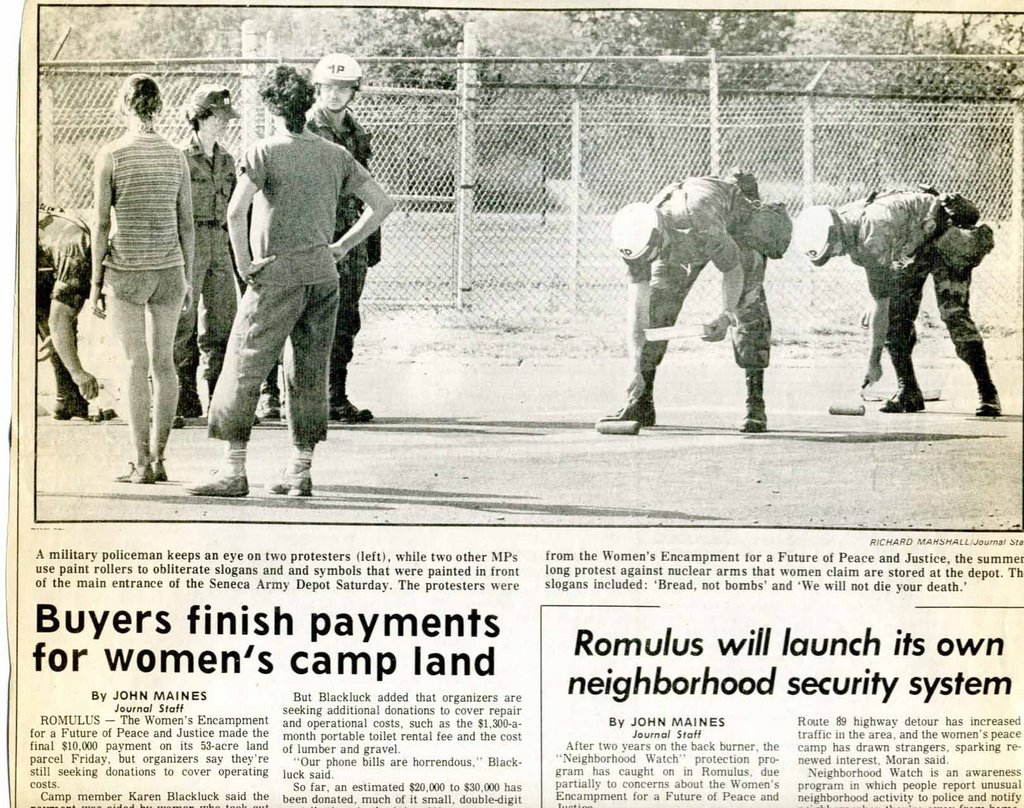
Caption: A military policeman keeps an eye on two protesters (left), while two other MP's use paint rollers to obliterate slogans and and (sic) symbols that were painted in front of the main entrance of the Seneca Army Depot Saturday. The protesters were from the Women's Encampment for a Future of Peace and Justice, the summer-long protest against nuclrear arms that women claim are stored at the Depot. The slogans included: "Bread, Not Bombs" and "We Will Not Die Your Death."
Photo by Richard Marshall

Buyers finish payments for women's camp land
by John Maines
ROMULUS - The Women's Encampment for a Future of Peace and Justice made the final $10,000 payment on its 53-acre land parcel Friday, but organizers say they're still seeking donations to cover operating costs. Camp member Karen Blackluck said the payment was aided by women who took out personal loans, clearing the camp's indebtedness to former owners of the land. When the transaction was made this spring, the women paid $17,500 down, agreeing to pay $10,000 on June 15 and $10,000 on July 15, bringing the total to $37,500, said Blackluck. The payments were made on time.
   But Blackluck added that organizers are seeking additional donations to cover repair and operational costs, such as the $1,300-a-month portable toilet rental fee and the cost of lumber and gravel. "Our phone bills are horrendous," Blackluck said. So far, an estimated $20,000 to $30,000 has been donated, much of it small, double-digit contributions in the $10 to $25 range. "To me that's amazing," Blackluck said. She said that the camp also received $1,000 from a Vermont peace group and another $1,000 from a New York City woman. The camp's costs include a contract with an ambulance service and a $2,500 bill for trucking water in during the season.

Friday, August 11, 2006

SoNG: Revolution Talk

Die-In action at the Seneca Army Depot main gate, August 9, 1983.

Revolution Talk
by WEFPJ Average Dyke Band* - Luna, Myke, Twilight, Helen, Hershe
PeHP Source: ADB songsheets 1985-87; Peace Camps Sings Cassette, 1987

You talk of revolution, I wonder what you see.
Did you read it in their history books or watch it on TV?
The only revolution this world has ever seen is the 
little man against the big man and they're all men to me.

They sell you constitution, I wonder what you know.
It's the white man taking power everywhere he goes.
They came over shouting "Freedom!" and grabbing with both hands 
with massacres and treaties to cage a sacred land.

Jodi tells her story she's been raped five times
and Estelle with their shock treatments fucking with her mind.
I hold their pain close to me it shakes me in the night.
Sometimes it makes me desperate, sometimes it helps me fight.

You study feminist theory in your universities
and fill your mind with book reviews and bibliographies.
When your sister calls for you are you really there
or is your sense of sisterhood just rhetoric in the air?

You talk of revolution, I've got a lot to say
of day-to-day rebellion in women-loving ways.
Whether we're holding hammers or cutting army wire
I know the wheels are turning like circles 'round the fire
.

A segment of the Average Dyke Band, July 1985 (from left) Gail, Liza, Woody, hershe, Helen, Jeanne-Michele, Luna (in back), robin (in front), Myke, Fish.


* The Average Dyke Band (ADB) sprang up at the Women's Encampment for a Future of Peace & Justice in the summer of 1985.  The theory they put into action was that songs, singing, and musical instrumentation were not the domain of an exclusive, talented few. They had found that far too many of their sisters fell silent musically because somewhere along the way they were told they didn't have a good voice, couldn't carry a tune, couldn't keep a beat. The ADB, then, was the musical counterpart to WEFPJ's consensus process philosophy and practice - every woman's voice would be heard. They were inclusive, they were average, and they had a damn good time.

NeWSPaPeR 5.16.82

Publication: Ithaca Journal
Date: May 16, 1982
Caption: Women demonstrators mock the military at an anti-nuke demonstration at the Seneca Army Depot near Romulus Saturday.

Photo: Richard Marshall.

Nuke protest at Seneca Depot
   Some 175 women and children from the upstate area protested the possibility that nuclear weapons are being stored at the Seneca Army Depot near Romulus Saturday. More than 50 Ithaca women attended, stopping in Trumansburg, Interlaken, Ovid and Romulus to pass out leaflets and present street theater on the way. 
   The women demanded an end to the secrecy about what is stored at the base and how it is transported there; economic conversion of the depot to provide productive, peacetime employment; and the dismantling of weapons stored there, organizer Gail Terzi said. She is a member of Ithaca Women Against Militarism and Upstate Feminist Peace Alliance. A letter had been sent to the base commander asking him to meet with the women. 
   A public relations officer who met with the protesters would neither confirm nor deny rumors of the presence of nuclear weapons at the base, Terzi said. Themes of the presentations included "bombs for the poor," cuts in social programs accompanied by an increase in the military budget, the arms race and the dangers of nuclear weapons; the inadequacy of civil defense and crisis relocation plans; and the possibility of an accidental nuclear war caused by equipment malfunction or human error, said Terzi. An earlier protest, also against nuclear weapons attracted more than 200 people Thursday to the main gate of the depot.

Tuesday, August 08, 2006

SoNG: Listen to My Heart's Song

Listen to My Heart Song
Origin unknown

PeHP Source: Peace Camps Sing produced by Sorrel Hays & Marilyn Ries, 1987; Peace Camp GatherSing, 2008.

Listen, listen, listen to my heart song.
I will never forget you, I will never forsake you.

Monday, August 07, 2006

~ WiND WaLKeR ~ Barbara Deming

Barbara Deming
Born: July 23, 1917
Died: August 2, 1984

Sunday, August 06, 2006

HeRSToRy 003 Karen Beetle

     Karen grew up in Albany, NY and had been an anti-nuclear activist for years before helping create the Upstate Feminist Peace Alliance and becoming one of the primary organizers of the Women’s Encampment for a Future of Peace and Justice leading up to and through the summer of 1983. She was a part of the Syracuse Women’s affinity group detained on the base for three days after going under the fence and setting up tents on the runway. Although she moved on from WEFPJ at the end of the summer, she participated in the October 1983 mixed-action at the depot and continued to be active in local anti-nuclear and anti-draft organizing, which led to a 3-month jail term in 1985. 

 Audio excerpt from Karen's interview:
TRANSCRIPT: "That’s why I think so much is about context. That action [Women's Peace Encampment] grew out of that time and I grew out of that time and we converged in that moment in that kind of way. And I think, what about my daughter, she’s 13, okay, when she’s 17, because she’s drawn to who activism made me even though she’s not necessarily drawn to activism because she doesn’t know that yet, but what will happen in five years that will draw her toward it? Something that captures her sense of creativity – because she’s creative, something that captures her sense of passion and care, what will it be and it will grow out of that time. So I can’t really back myself up and answer that question [Would the "today you" have been drawn to the encampment back then?] about if I was who I was, what would my relationship be? Then I wanted to offer the best thing that I knew to what was happening which in my mind was training and a sense of what the possibility of nonviolence would be so I think I always would have wanted to offer the most of what I knew to whatever situation I was in which is what I see myself doing now, so that’s what I’m going to continue to do. The venue that I’m doing it in doesn’t really matter as much. And  that will be whatever unfolds in front of me that I can connect to in a way that feels powerful. It’s important for everybody to be themselves in the world in a truthful way."
Interview: Karen Beetle
Date: December 14, 2005
Location: Albany, NY
Present: Estelle Coleman, hershe Michele Kramer

Miriasiem, Carolyn, and Karen (l-r) in the living room aka "pit" at the Peace Camp in 1983. Photo by Ruth Putter.
1983 ARCHIVE VIDEO:
 
Women's Video Collective. Copyright 1983. All Rights Reserved.
Karen (center) and Suzanne Sowinska speaking with a CBS reporter on the front lawn of the Peace Camp in early July 1983.

All these years later, what stands out for you about having helped organize the peace camp?
It’s the empowerment of having been there from the beginning and then knowing all of the things that came out of it. We got to create a reality that became a fixed part of the culture. That’s a very cool thing to do at age 20 - when do you ever get to do that? The feeling in that room in the fall of 1982 when we made that decision was incredible - we knew that it would be really powerful and we got to do it.


What was your history as an activist prior to the peace camp?
I grew up in a Quaker family in Albany. When my dad died in 1972 my mom took a pretty quick turn toward activism and by the time I was an early teenager she was very involved. I was attending peace vigils against the Vietnam War and in 1976 we took part in the Continental Walk for Peace and Social Justice from San Francisco to New York. We joined in on the feeder walk from Albany to New York City, so for the last two weeks of August, I walked from Albany most of the way to New York City - except that I had to go back to school. I campaigned for McGovern in 1972 with people from the Quaker meeting – I was 11. I was very aware and very involved at a very early age. I understood that peace had an impact on my life probably much more so than I would ever want my daughter who’s 13. I was also very involved in anti-nuclear activities along the Hudson River at Indian Point Nuclear Power Plant (1) and Shoram (2) on Long Island - but 1979 was when I really jumped into things. I was involved in the 50th anniversary of the stock market crash. We organized a civil disobedience action and that was the first time I was arrested - from that point until 1990, I was on a very fast activist track. I dropped out of college in 1980 to work for the American Friends Service Committee (3) - that was the year the draft came back so I was doing a lot of organizing around post offices which is where young men were registering for the draft. When the draft was initially proposed it was for women and men so there was a four month period before it became a men-only draft when we it looked like we were actually going to be getting drafted, too. In 1980 I went to the Soviet Union as part of a delegation because my overriding issue always had been nuclear weapons. I was part of conversations with Dr. Randy Forsberg (4) and others who were really looking at the damaging affects of nuclear war on the United States as a strategy to wake people up around the cold war which you know, as a young teenager is not really what you want to be spending your days doing. In 1981 went to the west coast and I did some organizing around some of the west coast nuclear facilities. I spent a year and a half out there and wanted to come back east so I applied for a job at the Syracuse Peace Council (5). I worked there from 1981 to 1985. When I got back here in 1981, one of the projects we were doing was organizing around nuclear facilities in New York state and our prime points of focus were the Seneca Army Depot [SEAD] (6), Griffiss Air Force Base (7) and Fort Drum (8). I was one of the people involved in the local organizing in New York state when this whole idea of a peace camp emerged. I was at the meeting when we talked about should we or should we not have a peace camp and what would it mean to do it at SEAD.


Tell us about the significance of the Women’s Pentagon Action.
The peace camp definitely grew out of the Women’s Pentagon Action (9) – in that it brought several of us from upstate New York down to Washington to gather with women nationally who were connected to peace organizing. Susan Pines was there from War Resisters League (10) and Kate Donnelly was there and that’s when we connected with the national network of peace organizing and women who were doing that. And it was the WPA that got us inspired to create the Upstate Feminist Peace Alliance where I met Carrie [Carrie Stearns PeHP 001] and Carolyn [Carolyn Mow PeHP 002]. We lived in three different cities but we were living the same lives in those cities. We were following what was going at Greenham (11) and we were already thinking we should do a woman’s action at a local nuclear facility. Then the Rochester newspaper ran an article about the role of the Seneca Army Depot and that really got us focused on doing it at the Seneca Army Depot.


Had any of you been to Greenham? No, none of us had but I think there was somebody at that first meeting about having a women’s peace camp who had been to Greenham. And Greenham was hugely interesting to us - we were already thinking about the Seneca Army Depot and Griffiss and that meeting really brought that all together. Carolyn and I were the people in that meeting who most embraced the whole picture of what was going to happen from a point of view of, what does this mean? and what is this time asking of us? because we were more of the strategists. Carrie was more, what’s this going to do to the organizing that exists? I didn’t really care about that – the camp was too great of an idea and I was always just really captured by a great idea. This had never been done in the United States and it was embarrassing that Greenham women were protesting against weapons that were coming from our country. We were feeling responsible for what our country was doing – and that was what really motivated us being at the local facilities – the sense that our communities were creating this huge international picture. We had the whole local organizing focus but it was always in the context of the bigger picture. So there was never anything but complete enthusiasm from me, being the idea kind of person that I am. I thought this idea is too good to pass up - we really need to make this happen, we really can make this happen

What was it about the times that made a women’s action such a good idea?
We were already moving in that direction - Cynthia’s Enlow had written Feminism and Militarism and Barbara Deming was doing all this really important writing, some of which was part of the initial Women’s Pentagon Action organizing. She was really the prime person articulating that vision that I really felt connected to, coming, as I did, from a pacifist tradition and being a feminist - that all really came together. So it wasn’t only that we’d been to the Women’s Pentagon Action (WPA) - the WPA grew out of a philosophical kind of convergence of these ideas. The WPA allowed our thinking to move from philosophy to actual experience. I think everybody was really excited about that because most of us had been feminist teenagers and we were coming from knowing that in our own experience. One of the things that I really understand a lot more after many years of being in activism is how powerful the time that you come into whatever you come into is. I’ve been organizing a children’s peace camp - Children’s Peace Week - for the last five years for the Quaker meeting locally. A lot of people in the meeting came into their activism during World War II but there are also a number of us who came into activism in the 1970s when for us, the front line of being yourself was about gender and sexuality and not so much about war. We were sort of post-Vietnam so that flavor was there but my experience of oppression personally was gay and lesbian issues and feminist issues. So at this children’s peace camp when we wanted to honor this particular gay person, the people who came into their sense of what is peace during World War II argued against it from the point of view that lesbian and gay issues are not the real issue. It’s not the real issue to them because it was never their real issue. What your real issue is, in my mind, has to do with what was your historical place is - what do you know through your own experience. And all of us knew through our own experience the importance of linking these issues because peace was a core issue to us for a lot of reasons – for me because I grew up in a pacifist world - but issues of gender and sexuality were close to our heart because they were our issues. So that was the personal piece that made the theoretical writing about peace and feminism and the practical experience of the Women’s Pentagon Action completely real for me and us and the peace camp grew out of those things in us. There was a sense of timeliness about it which is kind of hard to explain now but which really awoke everybody and got them there because everybody felt it. 


 How did you deal with those in the peace movement who didn’t think a women’s peace camp was a good idea?
I knew we would come up against people who weren’t happy with the idea but I was never that worried about people who were unhappy about a good idea because I had a lot of faith in the idea to prevail and I had a lot of faith in our ability to articulate what the peace camp was about and why it made sense. I didn’t have any capacity to worry about anything because I was just really excited about the idea and what it would mean. The idea of a peace camp pulled together really important things for me - inside myself and outside in the world. I was 20 – when you’re 20, you don’t think, I can’t do this, and you don’t think how much work this is going to be, you just think, great! This is fantastic! We’ve got to do this!
I was grumpy at people like Carrie who were dragging their feet saying, what about this and what about that? So I ended up playing the role of articulating what it was about and why it made sense because it did make sense to me and I didn’t have any issues about that. We did a lot of talking about why it was a women’s peace camp because those discussions were important. I was always willing to dialogue about that even though I wasn’t particularly movable on that question but it felt important to create space to discuss that and I didn’t have any resentments that felt like they couldn’t be overcome.
We had to deal with the Romulus/lesbian reality which was a complete clashing of cultures but there was no way that the lesbian issue was ever going to be back burner at the peace camp because of the fact that all of this for us evolved together and it was going to be a convergence of everything. It did create a fair amount of flack with the male peacemakers locally but I was totally willing to take them on and I was willing to take on those Rochester-area male peace activists who felt tremendously turf-threatened by this action because I had the perspective of both the timeliness of this whole picture and a care about the local organizing. There was definitely resistance from men and male peacemakers, particularly the male peacemakers – men in general, I think, weren’t as threatened as the male peacemakers were. At the Peace Council there were some men there who were just grumpy from this perspective of, this is a seriously cool thing that I can’t be a part of, which I had no room for. I thought they really should get over themselves about that because this really was what needed to happen.

Speaking of male peacemakers, how did your experience of civil disobedience at the peace camp differ from your experience of civil disobedience in mixed actions?
There’s so much in the male peace movement of arrest as right of passage and it’s really tiresome. I had been organizing around draft issues so there was always this, the men are important kind of thing going on and the peace camp was really a beautiful chance to see all of that be done differently and be thought of differently and become different. I had been involved in all kinds of affinity groups – probably five by that point – that had support people and in each one, the role of support people was limited – it was press contact, move the cars to the other side of the street but it was really the women’s peace movement that brought a sense of nurturing and family connection to that and it was a really different way of thinking about who we were and what our responsibilities was to each other so that was really beautiful and empowering and sustaining for those of us in it. My women’s affinity group in Syracuse and Carolyn’s became these families of women - I can’t even tell you the kinds of things that my affinity group did when were held in the depot during the Aug. 1 action. They just did everything that you could possibly want them to do – they brought us food and tried to get them to bring it into us and they said, look, they’re vegetarians, they’re not eating what you’ve got for them, we made them food and we want to bring it in. They took care of everybody’s cars, everybody’s houses, called our roommates, got our plants watered, went to court when we were there, demonstrated outside court before we got there. We really worked on the role of support person versus person arrested and saw the action as a seamless community of people creating change – there wasn’t this sense of us/them. It’s a very comprehensive view of what it means to be part of an action and I feel like it was the women’s peace camp and the feminist peace movement that brought that whole sense of nurturing to it in a very different way.


How did you deal with negative media attention? 

I was undeterred by the negative press and all that kind of stuff because there’s always negative press – that wasn’t the enduring quality of what we did – the enduring quality of what we did was reflected in our presence there, in our commitment to the issues and the way we expressed ourselves there. I would get grumpy at the press like, aargh, do they have to take these pictures? Why are they always showing someone ripping off their shirt and hanging it on the fence – to me that sensationalism was a distraction. But even so, there were a bunch of editorials at the time in the Syracuse papers a lot of dialogue in the press in general about what the essential message of the peace camp was. I didn’t feel like that ever got lost.
My thing was nonviolence training because I really wanted to bring the whole history of nonviolent organizing to the camp experience. I wanted it to be really a conscience, reflective, Gandhian action - which it wasn’t for a lot of people. A lot of people were just in to the party energy of the peace camp and I was okay with that. I didn’t judge that, but I did try to bring to it, through the handbook and nonviolence trainings, a sense of its place. I always had that bigger picture, organizing strategy bent – I was considered one of the clipboard women at the camp because that’s what I was doing. I coordinated non-violence trainings and helped write the handbook with a group of other people and though I had put together probably eight other handbooks for actions in the 80s, we pulled a lot of new material for the Seneca handbook (12) because we were really trying to make the link between feminism and nonviolence and we really wanted to talk about the history of the region. It was very important to me to bring a woman’s perspective to the question of militarism because I had a strong feminist perspective. I trained peacekeepers and I watched them get swept up in the moment and lose track of peacekeeping. But I was always really curious about how the moment captured people and the camp was a huge opportunity to see how people become affected by setting up a particular situation. All these things happened – the counter-demonstrators happened and the empowerment happened and the new lesbian relationships happened and a place in history became attached to the camp and the land and it was tremendous grounds for just watching something unfold. It was a fascinating thing to get to do.

Carrie spoke about feeling overwhelmed once the camp opened and so many women showed up – how did you deal with the influx?
As long as it was all working out okay enough, I was okay As long as I was able to be part of it and still have my view - play the role that I wanted to play by doing the nonviolence trainings and bringing the perspective that I wanted to bring to it, I was okay. I felt like sensationalism happens - it happens anywhere - and I was into staying connected to my own motivation and the core part that this was about and I guess I didn’t fear the out of control nature of it, I just saw that that was happening and stayed connected to what was important to me and didn’t worry about where it was going. And it didn’t ever go anywhere that was truly awful, nobody murdered anyone at the peace camp - it stayed within a level of irritating at times or annoying or but nothing awful. And I never felt like people weren’t willing to dialogue - I just felt like people would dialogue about something and then they would get caught up in the moment and whatever dialogue they had just finished having went out the window. That theme reemerged for me in this huge way when I was involved in doing Central America organizing - Carolyn and I went on to do this huge amount of work for Peace Brigades International (13) and at times we would be the only people in the U.S. offices. We would have people on teams in Central America and the communication between the teams and the offices was always surreal – like the teams would say this and we would say this and we’d be like, what are they thinking!?! And they’d be like, what are they thinking!?! So finally Carolyn went down and she was on the El Salvador team and I was thinking, thank god! But it didn’t take long before I was talking to her and she said, what are you guys thinking! So it was just a huge wake up call that once you’re in a reality your perspective is shaped by that reality.

Given that the influence was Greenham, why and how did you all decide to buy land?
If there’s one thing that was the hugest thing for me about the peace camp it really was that whole land piece because I just learned so much about people’s connection to land through that process. For me the land was a tool. I was an activist. I was a strategist. We needed a place to be and it was not looking very logistically possible to pull off this camp without that piece of land. We had no idea what we were deciding when we decided to buy that land. We spent a lot of hours on that question and it was extremely intense. The argument that was swaying people in the direction of buying land was that we were going to have a lot of people coming and people on the committee couldn’t imagine how that all would take place without some kind of home base. I would never have gone that direction. I had a home base - I lived in Syracuse it was only an hour and a half away and I was used to this kind of thing. I was used to occupying nuclear power plant land and setting up camp there or whatever so I fought buying land. It wasn’t my inclination to use resources that way. But we already had a lot of land kind of people – and I’m thinking it was probably the festival influence. (14). In the beginning nobody would have bought land but by the time we were actually addressing that question it was several months later and we were a much bigger, more diverse committee and the diversity included people who had very much of a festival orientation. It’s a lot easier to take the festival model for a large group of women coming together so that was a huge influence. I was to the bitter end someone who said, I don’t think we need this land, but I saw that we weren’t going to be able to fight it. I saw that it had a lot of power behind it. In the end if we had just gotten the land and ditched it and moved on, I would have seen it as any other logistical question because the land per se was not a problem for the action - it ended up being a great staging ground. It was the attachment to the land that became the issue. But given how many people came and given that it was so far from where we lived - it worked. It wasn’t my vision but I don’t think I fought it in a big way once I realized that it really was happening. It always felt like we were on the edge of being able to manage all of the aspects and tasks that were required for this because they were numerous and they were just absolutely huge – the money piece, paying people and getting bank accounts established and all of that - if you’re doing it locally it’s a little bit easier – you just have your meetings with four or five of you, you make these decisions - but there were a lot of decisions that needed to be made and the infrastructure felt huge. We were all involved in these other organizations so it was always a question of, could my organization do this? Well, we’ve got a mailing list and we’ve got… so it was always trying to figure out what to do with these various resources, how to pull them together and in my mind, would they get pulled together. It felt like a huge thing and paramount in that was the buying the land question. None of us in that room during those lengthy land discussions had any idea what we were talking about in terms of what that land would become. 

 
What was your take on the meeting at the end of that first summer when women decided to hold onto the land?
For me, land was about strategy – buying was about something that would work and it made no sense to me to do anything other than ditch the land once we were through. So when we were at this meeting in Albany post-peace camp (October, 1983), where we were talking about ditching the land, I just could not believe that there was so much sentiment for keeping the land. I was like, of what resource is this thing? I wasn’t somebody who was invested in that land, I probably didn’t know what it meant to be invested in that land except I came to understand that other people really were invested in that land and the longer you were on it, the more people got invested in it. It became a symbol of something for people. For me there was tremendous learning around the choices you make and the implications they have because I never ever saw it that way and I was so bummed because I really wanted to give it back to the Cayuga Nation (15) as part of the land claim. I thought, what better thing could you do than make a symbolic gesture of returning what was and should have been theirs in first place. But everyone had all these practical problems like, well, what will they do with it? and I’m like, who cares? It doesn’t matter what they do with it. So there I am being a complete idea person and the perfect idea here is to return the land, do a press conference and symbolically hand the land over – that would’ve really been a slap in the face of the U.S. government. The only other idea I remember from that time was to turn the camp into a battered women’s shelter and I was just like, why?!? I thought that idea made no sense at all in terms of safety, visibility – all of those things. It didn’t strike up in my mind anything that would really be nurturing for women in difficult situations. I guess we could’ve sold the land and then bought something somewhere else for a shelter. I would have been amenable to selling it and using it for other purposes – seeds for the next action or whatever because the money to get the land in the first place came from people who really believed in this idea, who really wanted to see a Greenham Common in America. If you talk about what was the motivation for people who gave us money it was to put this on the map in America. I totally would’ve gone with any idea to sell the land and use the money as a fund for women’s future peacemaking actions or something like that but there was nothing in me that wanted to keep the land or see the project continue. I was just baffled at the Albany meeting but I thought, okay, this is pursuing another path and I could tell really clearly that it had its own energy. I just took in what happened with the land as information that I really needed to digest over many years about how that really is for people because it is true for people and so I didn’t fight it I just really took it in and thought, this is truly fascinating – that the land is more powerful than our intent here, the land is more powerful than the idea. It’s a good thing to know about land - that tells me a lot about Palestinian issues, it tells me a lot about land claims, it taught me a lot. In the meeting people would say, well, somebody died and we brought their ashes and spread them on the land. The investment in the land itself had a lot to do with people’s memories. My memories were not attached to that land at all, that’s not where memories are stored for me. But for other people, walking on that boardwalk, the port-a-potties - it’s just very real and to maintain that land is to maintain those memories. The people who wanted to keep the camp alive had a different energy and for me, an unknown energy, so I just scooted back into the world that I knew and continued doing what I had been doing. I was in this allowing place around the land and what happened there but I wasn’t connected to it after that summer and none of my friends were connected to it.


So after that October meeting you were no longer involved with the camp?
I continued to do actions there and my commitment to the issue remained and I went on to be arrested numerous times at Griffiss Air Force base but I definitely moved on from the peace camp and I moved on from women’s peace organizing because it didn’t take another direction. I didn’t actually move on in the full sense because the Syracuse women’s affinity group stayed together and we continued to do things in Syracuse for a while after that. We were a core affinity group for the national actions in Washington after the Supreme Court sodomy decision – we went to that action and had a women’s presence at that action. The Syracuse women’s affinity group had a longer life than just the peace encampment – we were together for another three years doing various kinds of things. It existed before the encampment and existed after the encampment and for the most part the women I was involved with and doing organizing with were not involved in the encampment to a large extent after the summer of 1983.

 
                          Syracuse Affinity Group, 1983

What did your activist life look like post-peace camp?I took the feminist perspective from the peace camp and went right into women’s anti-draft organizing. We did a shut down selective service action in Washington which we had a women’s affinity group for and I was hugely involved in Andy Major’s indictment and trial. He was one of the people targeted by the Justice Department as a non-registrant. We did all kinds of stuff around his trial. We had theater pieces for all of the stages of his trial – the indictment, the pretrial. We did a collective pretrial motion kinesthetic motion piece in the federal lobby area. We had 250 people for his trial and I was involved with all of the logistics about that. I had 104 degree fever the day of his trial and it was 20 degrees below zero and I remember sitting in the car thinking, OK, do I go home or do I go to Upstate Medical Center? It was a very, very intense time for me. I was also involved with him and he was going to jail for six months. Carolyn and I were arrested at his trial and we were in jail briefly and that ended up being what sent us to jail for three months in 1985. Carolyn and I were both arrested at the federal building on June 12th in this day of actions that people all over the country did and we got the longest sentences of anybody - 105 days because we were re-sentenced on our convictions at Andy’s trial. We were arrested at the congressional offices – carried out of the U.S. Attorney’s office on the U.S. Attorney’s leather furniture which was kind of fun but then recharged on the first conviction. So we got 60 days for the U.S. Attorney’s office and 45 days for that second action. That was a powerful moment – they put leg shackles on us for our sentencing which they never do to people charged with misdemeanors. We’re standing there with our arms and legs shackled, me and Carolyn with the judge who had just sentenced us to 60 days and then he says, OK, now your former judge is going to come in and re-sentence you on your conditional discharge. So we had a moment to seek mitigation in our defense and all I’m saying in my mind is, concurrent, concurrent, concurrent – whatever they give us but just get it over with! So he says, 45 days consecutive and I was just aarghhh! So we were in the Onondaga County Jail from Oct. 11 to Dec. 5, 1985.

Has your civil disobedience arrest record been a challenge when filling out applications and such?
To get liability insurance I had to list the actions that were misdemeanors and I realized I only have three counts that were misdemeanors and none of them had to do with the peace camp – those were all violations. Carolyn did three months in Onondaga County Jail and she actually recommended to me – through her lawyer to do a completely behavioral picture of what I did, to say, I sat in the U.S. Attorney’s office, the office closed and we were arrested on the day that congress was voting on aid to the military government in El Salvador. And that’s how I’ve always portrayed it – I was weaving yarn across the entrance to Griffiss Air Force Base… so you’re conveying a sense of your intent and the ambiance of the demonstration but you’re not making a political argument. That’s actually been the cleanest way to articulate it and it’s a really powerful way to articulate it too, because then people are thinking, well, why would she be weaving yarn across the entrance to Griffiss Air Force Base?” Carolyn helped me with that and I’ve had actually no problems whatsoever – people find it colorful, you know what I mean? If you say, I was arrested. I don’t tell employers that I did the three months, but I would certainly tell a client that has a dad in jail or whatever because it’s a way that we are connected. I listen to court descriptions and information through the perspective of having been a defendant and it’s tremendously helpful – anything you do in your life is tremendously helpful for you. When I became a nationally-certified counselor, in the ethics section of the application I checked off that I had been arrested and wrote them a letter and they wrote me back the sweetest letter saying, we really appreciate your honesty, now that’s what makes you a great counselor, we want to embrace everything that you are. I’ve never gotten a response like that.

So back to your post peace camp adventures, what did you do after serving your 105 days?
I got involved with Peace Brigades and went to Guatemala for three months in 1986 and came back and organized for Peace Brigades – there was no U.S. office so I created a U.S. office and trained volunteers. I was the emergency response contact for the team – I’m getting stressed out thinking about this – and it was like going out of the - I’m going to forget the analogy, out of the frying pan into the fire because I just finished jail. It was a culmination of all these years of direct action after direct action and then I went into Guatemala and we were escorting people who had disappeared 
t
family members and I was learning a language - I spoke Spanish - but I spent a month in language school. And personally for me - I was in my later 20’s - a lot of my family trauma issues were getting activated by the disappeared relatives. I think I actually put myself in that position because I was working through that, but what got me there politically - and who knows exactly what that motivation was about - was really wanting to be on the cutting edge of nonviolence. I’d always wanted to be in the place where I felt like nonviolence was really being tested and the people in Guatemala were using nonviolence as their means of protest and we were using the escorting idea - protective accompaniment - as a way to really further the thinking on what nonviolence could mean in that particular setting. Being the strategist and idea girl I was, I wanted to be a part of that unfolding idea. I designed the training programs and all that kind of stuff so that I became a thinker too about how to prepare people for this environment. I ended up being the emergency response contact so I ended up having to create this whole congressional network for support to the team members of the disappeared. I had to tell these parents that their daughter had been knifed. It was a very intense experience. Carolyn was completely involved in that with me - she was on the team in El Salvador and we ran the office out of Albany. In 1990, I crashed and just could not do that anymore. I could not be on the front line of activism and I had to really look at what in me motivated me to be on the front line of activism in a way that was not a nourishing, holistic personal vision for myself and I had very few ideas about what that was … what that meant for me so I really needed to understand in myself what motivated me and brought me to that. I have not been involved as an activist doing direct action since. What I did after that is I recuperated for a year and a half. Carolyn and I both worked at the CSA farms here and I spent a summer bagging spinach. I just really needed to slow down, re-center and I did a lot of reflection. I did a lot of, eventually, just feeling the bodily experiences of everything I had been through over the course of many months - just allowing tension in my body to release. I realized at that time that what fueled my mother’s activism was my father’s death and I know in me now that a lot of my activism was fueled by unfelt grief. I was always really curious about what was the edge for me? What was the driven-ness that I found in myself and in other activists? I would run into people who weren’t driven and I would really feel the difference between my own activism and those people who I felt like were coming from a more centered place in themselves. As time went on I was more aware that there was another way to be so I spent all of the next chunk of time really cultivating in myself another way of being that will hold the space for my own grief and the grief of the world and a vision of that that I can hold.
 

How are nonviolence and peace a part of your non-activist life?
I am a therapist with kids. My practice right now is psychotherapy counseling and mindfulness so I’m really developing that aspect of my practice which is about teaching mindfulness. Children’s Peace Week - which is the only project that makes my mother happy because she wants me to be an activist – is for kids 5-12 and the first day we teach about peace with yourself, the second day we teach about peace in your family, the third day we teach about peace with friends and neighbors, the fourth day we teach about peace in the environment and the fifth day we teach about peace in the world. So I get to construct this curriculum which is really about learning about peacemaking by finding peace in yourself and moving it out into the world and I love that, I love that chance to work with kids and help them find a sense of stillness so that’s really the primary work that I’m doing now is helping people reconnect with a sense of stillness and possibility and to kind of move that out.
I just got a client this week who is a fourth grader whose family’s from India and his aunt lives in Delhi where the bombings were and he is really having a hard time – he’s having a hard time being 10 and knowing what’s going on in the world and trying to understand that in himself and sit in his fourth grade classroom and make that work. I feel like this is a full circle for me of being a child activist and having this vision that things can be different but what can I do, I’m 10. I’m really happy to sit with a 10-year-old and sort of help him sort out – how do you care and still feel safe - because nobody helped me sort out how you care and still feel safe and I want him to care so I’ve put myself right now in my life in a place of being a resource for people to be who they are and have a caring relationship to the world and have a sense of balance.
Spiritually I’m no longer really connected to Quakerism and the Quaker Meeting, I’m not living in t
he world of Quakers but I’m very connected to it and the Meeting sees me as their child and so that’s just how it is. I’m into a more Buddhist practice now - doing a lot of sitting meditation and doing a little teaching meditation sometimes with the mindfulness practice so that’s kind of what’s been nourishing me. I also became a parent in 1992 and being a parent is very process oriented for me in thinking about what it means to raise a child who is herself, who is caring, who is able to kind of live in the world of her time and make it hers and care from a place that is authentically hers. So that’s kind of what I’ve been growing in me, in her, in my kid clients and the world and to me it’s all one seamless piece.                                          

Do you have a sense of where this evolution will lead you in 20 years?
I’ve been idea-driven but I haven’t been vision-driven, so that’s hard to say. Have you heard of Carl Kline? He’s an activist in the midwest and he came to Peace Brigade and he embodied something that I had never seen - a sense of stillness and a sense of connection to activism. I got the Peace Brigade’s newsletter and looked at the pictures and he’s the only person that I still know that’s on that national committee. I think, will I ever come back to a relationship with activism? Will it ever be an activist thing that I do? Local activists did a peace conference here recently and one of the things they talked about was fear and I’m really interested in fear from the perspective of what does it mean to create a sense of resilience in the face of fear? I did a workshop for the local Catholic Worker about strengthening inner resilience and I’ve thought about doing things with Carrie that would be connected to the activist world on the question of cultivating resilience. I also think about using expressive arts techniques in some areas of the world that are experiencing trauma. So I could do international work which would probably be about trauma and expression, and I could do work related to cultivating stillness with the activist community which is what I’m doing through the Peace Week. Sometimes I think if they really knew where I came from would they want me to direct the week because every once in a while they say they want it to be more of an activist training program - and it’s not. It’s a program to experience peace and it is so popular and the kids who come really love it. They say this is like nowhere else and that they wish school could be like this. So I’m sort of subverting the Quaker’s activism model by having these kids really love getting to be together in a way that feels different. I don’t know what really changes - it’s just a question in my mind, I guess, about how big is people’s vision of what peacemaking is? I could be inside it or outside it, if you draw a small circle of what it is, I’m outside it; if you draw a big circle of what it is, I’m inside it. And I think, truthfully, that the bigger circle is where things are going - in terms of people’s perception of what peacemaking and change means now. I think people are realizing a bigger vision of it is a helpful thing.

If you were who you are now and it was 1983 and you heard about this women’s peace camp happening at the Seneca Army Depot, would you be drawn to it?
I think so much about activism is context – that action grew out of that time and I grew out of that time and we converged in that moment in that kind of way. And I think, what about my daughter, she’s 13 and when she’s 17 (because she’s drawn to who activism made me even though she’s not necessarily drawn to activism because she doesn’t know that yet), what will happen that will draw her toward it? It will be something that captures her sense of creativity, something that captures her sense of passion and care and it will grow out of that time. So I can’t really back myself up and answer that question - at that time I wanted to offer the best thing that I knew to what was happening which in my mind was training and a sense of what the possibility of nonviolence would be so I think I always would have wanted to offer the most of what I knew to whatever situation I was in which is what I see myself doing now so that’s what I’m going to continue to do. So the venue that I’m doing it in doesn’t really matter as much and that will be whatever unfolds in front of me that I can connect to in a way that feels powerful. It’s important for everybody to be themselves in the world in a truthful way.

Do you ever get a chance to flex your peace camp peacekeeping muscles?
I went to the 2000th Soldier Killed in Iraq demonstration (16) with my daughter there was a counter-protester there but there are no peacekeepers. The counter-protestor was saying all these things and nobody was doing anything and my daughter was like, “why is he saying all these things, why doesn’t he move on?” And then I sort of found myself talking about what a peacekeeper does and I actually did talk to the person talking to the counter-demonstrator to ask him a few questions, like, do you think what you’re saying is helpful right now for him or for you and how’s it helpful? And he was like, what?!? But that doesn’t matter because then he engaged in a dialogue with me, he calmed down and he said, well, yeah, I think I am really angry right now, and I said, I could tell you were angry, so, so, so thank you for being willing to talk with me about that and my daughter was like, what are you doing, Mom? And I’m like, just diffusing things. So there is an attachment to that role of peacekeeper and an understanding of what it plays which I sort of got a window into in that moment and how important I still find that to be.


1. Indian Point Nuclear Power Plant- a three-unit nuclear power plant station located in Buchanan, New York just south of Peekskill, New York, on the east bank of the Hudson River, approximately 35 miles (56 km) north of New York City. Interest in shutting down Indian Point dates back to 1979 following the Three Mile Island incident, a partial core meltdown with no injures. Indian Point has become controversial to environmental activists and there has been renewed interest in shutting down the plant since September 11, 2001.

2. Shoreham - a 455-acre site between the sparsely populated hamlets of Shoreham and Wading River in Suffolk County, NY bought by Long Island Light Company in 1966 to build a $65-$75 million nuclear power plant for use by 1973. The plant never opened however because following the accident at Three Mile island, the citizens of Shoreham did not want a nuclear power plant in their community. In June, 1979, 15,000 protesters at the site participated in the largest demonstration in Long Island history. Police made 571 arrests. Shoreham citizens prevailed against all odds and prevented a completed and fully licensed nuclear power plant from operating for the only time in American history. By the time Shoreham was fully decommissioned on Oct. 12, 1994, its $6 billion price tag -- about 85 times higher than the original estimate -- had nearly wrecked the regional economy.

3. American Friends Service Committee - a Religious Society of Friends (Quaker) affiliated organization which works for social justice, peace and reconciliation, abolition of the death penalty, and human rights, and provides humanitarian relief. The group was founded in 1917 as a combined effort by American members of the Religious Society of Friends and assisted civilian victims of war.

4. Dr. Randall Caroline Forsberg - wrote the "Call to Halt the Nuclear Arms Race," the four-page manifesto that launched the national Nuclear Weapon Freeze Campaign where she served as co-chaired on the national advisory board, 1980–1984. Dr. Forsberg also founded IDDS in 1980, an independent nonprofit center for research and education on ways to reduce the risk of war, minimize the burden of military spending, and promote democratic institutions. She is the editor of the forthcoming IDDS annual survey, ArmsWatch 2005: Global Trends, Prospects, and Policy Options and has authored or co-authored several books on nonproliferation, defense, war, peace, and more.

5. Syracuse Peace Council - antiwar/social justice organization. It is community-based, autonomous and funded by the contributions of its supporters founded in 1936. The Peace Council educates, agitates and organizes for a world where war, violence and exploitation in any form will no longer exist. It challenges the existing unjust power relationships among nations, among people and between ourselves and the environment

6. Seneca Army Depot (SEAD) – a former U.S. military base, pre-1941–2000. Located on 11,000 acres in Romulus, New York, the depot was one of several facilities used to store nuclear weapons for the Department of Defense. The earliest known use of SEAD for nuclear weapons related work was in the 1940’s when uranium was stored at the depot for the Manhattan Project (the project that developed the atomic bomb). SEAD was approved for Base Realignment and Closure in 1995 and closed in 2000.

7. Griffiss Air Force Base – 1941-1995 - former U.S. Air Force base in Rome, New York. home to the 416th Bomb Wing and equipped with the B-52 Stratofortress. The base was realigned for civilian and non-combat purposes in 1995. It is now home to the Griffiss Business and Technology Park, and it is still home to Rome Labs. At its peak, the base was the largest employer in Oneida County, New York. Griffiss was the site of the notorious Woodstock 1999 concert festival.

8. Fort Drum - a military reservation in Jefferson County, New York consisting of 107,265 acres. Its mission includes command of active component units assigned to the installation, provide administrative and logistical support to tenant units, support to tenant units, support to active and reserve units from all services in training at Fort Drum, and planning and support for the mobilization and training of almost 80,000 troops annually.The population was 12,123 at the 2000 census.

9. Women’s Pentagon Action - a nonviolent, direct action in which 2000 women blocked three entrances to the Pentagon on Nov. 16, 17, 1981 to call an end to the nuclear arms race. 143 were arrested. A second Women’s Pentagon Action took place November 15-16, 1982.

10. War Resisters League - formed in 1923 by men and women who had opposed World War I. It is a section of the London-based War Resisters’ International. In the 1960s, WRL was the first pacifist organization to call for an end to the Vietnam War. Their opposition to nuclear weapons was extended to include nuclear power in the 1970s and 1980s. WRL has also been active in feminist and anti-racist causes. They also work with other organizations to reduce the level of violence in modern culture. Today, the War Resisters League is actively organizing against the wars in Iraq and Afghanistan as well as the impact of war at home. Much of their organizing is focused on challenging military recruiters and ending corporate profit from war. They publish the quarterly magazine WIN: Through Revolutionary Nonviolence and are involved in a number of national peace and justice coalitions.

11. Greenham Common Women’s Peace Camp – an ongoing nonviolent protest outside the U.S. Air Force base at Greenham Common in England, 1981-2000. On August 28, 1981, 40 women marched 110 miles to the U.S. Air Force base at Greenham Common, the proposed site of 96 U.S. cruise missiles. Eight days later, four women chained themselves to the air base fence. From this direct action a women’s peace camp was born. On March 21, 1982, 10,000 people demonstrated at the base. 250 women engaged in a 24-hour blockade – 34 were arrested. On December 12, 1982, 300,000 women linked hands to embrace the 9-mile fence encircling the base. Although the last of U.S.’s 96 cruise missile were removed in 1991, women stayed on at Greenham until 2000 to ensure that the base was closed down. In March of 1997, the land was purchased by the Greenham Common Trust and returned to a variety of civilian uses.

12. Women’s Encampment for a Future of Peace and Justice Resource Handbook, 1983 – A 51-page peace camp preparation manual containing information on nonviolent action, feminism and nonviolence, the European disarmament movement, the Cayuga nation and the local area.

13. Peace Brigades International – a non-governmental organization founded in 1981 to protect human rights and promote nonviolent transformation of conflicts. It primarily does this by sending volunteers to accompany human rights workers whose lives are at risk in areas of conflict. In 1983, the Peace Brigades’ first team was sent to Nicaragua during the Contra war. In 1989 in Guatemala, a grenade was thrown into a Peace Brigades’ house. Three months later, three volunteers were stabbed walking home. In El Salvador, five volunteers were arrested and temporarily held until being asked to leave the country. One volunteer was severely beaten. Past projects include the Balkans, Sri Lanka and Haiti. Current projects include Colombia, Guatemala, Indonesia, Nepal and Mexico.

14. Michigan Women’s Music Festival – a yearly all-female gathering on privately-owned land in northwestern Michigan each August since the 70s. The festival is marketed as a cross-generational multi-cultural event for womyn to gather and listen to concerts, make art, explore politics and community, live simply among the meadows and woods and have an outrageously good time. The Michigan community is based upon an essential participatory ethic and is designed and crafted each year by a new combination of womyn, ranging from first-timers to those who have worked on it for over 30 years.

15. Cayuga Nation - the Gayogoho:no, which means People of the Great Swamps. This name refers to the marshy lands that were a part of their original homelands. The Gayogoho:no, also known as the People of the Pipe, are one of the original Five Nations who joined together with the Mohawk, Onondaga, Oneida, and Seneca to form the Haudenosaunee Confederacy, which is also know as the Iroquois Confederacy. The original homeland of the Cayuga Nation extends from Lake Ontario to the Susquehanna River, which includes the land that housed the Women's Encampment for a Future of Peace and Justice. The Cayuga were forced onto a 64,000 acre reservation in 1789 and lost additional land illegally when the state of New York bought reservation land in 1795 and 1807. The Cayuga have been attempting to regain their land since 1849 but to this day do not have
a reservation or land base. In the early 1980s, the tribe successfully sued the state of New York for the return of 64,000 acres and a federal judge awarded them $247.7 million in damages. The case has been appealed and as of May 2005, is awaiting further proceedings.

16. October 25, 2005 - nationwide demonstrations against the U.S. invasion and occupation of Iraq commemorating the 2000th U.S. soldier killed there.